
You're comparing oxygen concentrators online, and two technical terms keep showing up everywhere — continuous flow and pulse dose. Nobody explains what they actually mean in plain language, and picking the wrong type isn't just inconvenient, it can mean the device doesn't deliver oxygen the way your clinical prescription actually requires.
Here's the difference, broken down simply, so you can have an informed conversation with your doctor or equipment supplier instead of guessing.
The Core Difference: Continuous Flow vs Pulse Dose Oxygen Concentrator
Continuous flow delivers a steady, unbroken stream of oxygen at a fixed rate, whether you're inhaling, exhaling, or pausing between breaths. It doesn't adjust based on your breathing — the oxygen just keeps flowing steadily at whatever litres-per-minute (LPM) setting your doctor prescribed.
Pulse dose (sometimes called "demand flow") works completely differently. It uses an internal sensitive pressure sensor to detect the exact millisecond you start inhaling, releasing a measured bolus or burst of oxygen right at that moment. Between breaths, when you exhale, no oxygen is wasted or released.
Pulse Dose Oxygen Concentrator Explained
Pulse dose technology was largely developed to make portable oxygen concentrators (POCs) significantly lighter and battery-efficient. Instead of running a compressor constantly to pump oxygen non-stop, the device only draws power to deliver oxygen when an inhalation is detected, conserving battery life dramatically.
This makes pulse dose units popular for individuals who are mobile and need oxygen support while active — running errands, visiting relatives, traveling, or moving around during the day.
The trade-off is that pulse dose relies on detecting a strong, consistent inhalation to trigger delivery. For patients with very shallow breathing, mouth breathers, certain irregular sleep patterns, or advanced respiratory conditions, this inhalation detection isn't always reliable — which is exactly why a doctor must confirm whether pulse dose will meet your oxygen saturation targets before you commit.
Oxygen Concentrator for COPD Patients — Which Delivery Type Fits Better?
Chronic Obstructive Pulmonary Disease (COPD) patients often have fluctuating oxygen requirements throughout a 24-hour cycle — lower requirements while resting, but higher demands during physical exertion or acute flare-ups. This is where the continuous vs pulse dose decision becomes nuanced:
- At rest or during sleep: Many COPD patients are prescribed continuous flow. Breathing can become shallow and mouth-based during sleep, and continuous delivery does not depend on inhalation trigger sensors.
- During activity or travel: Pulse dose units are frequently preferred for their lightweight portability (often 2–3 kg), assuming the prescribed LPM volume and breathing pattern match pulse delivery.
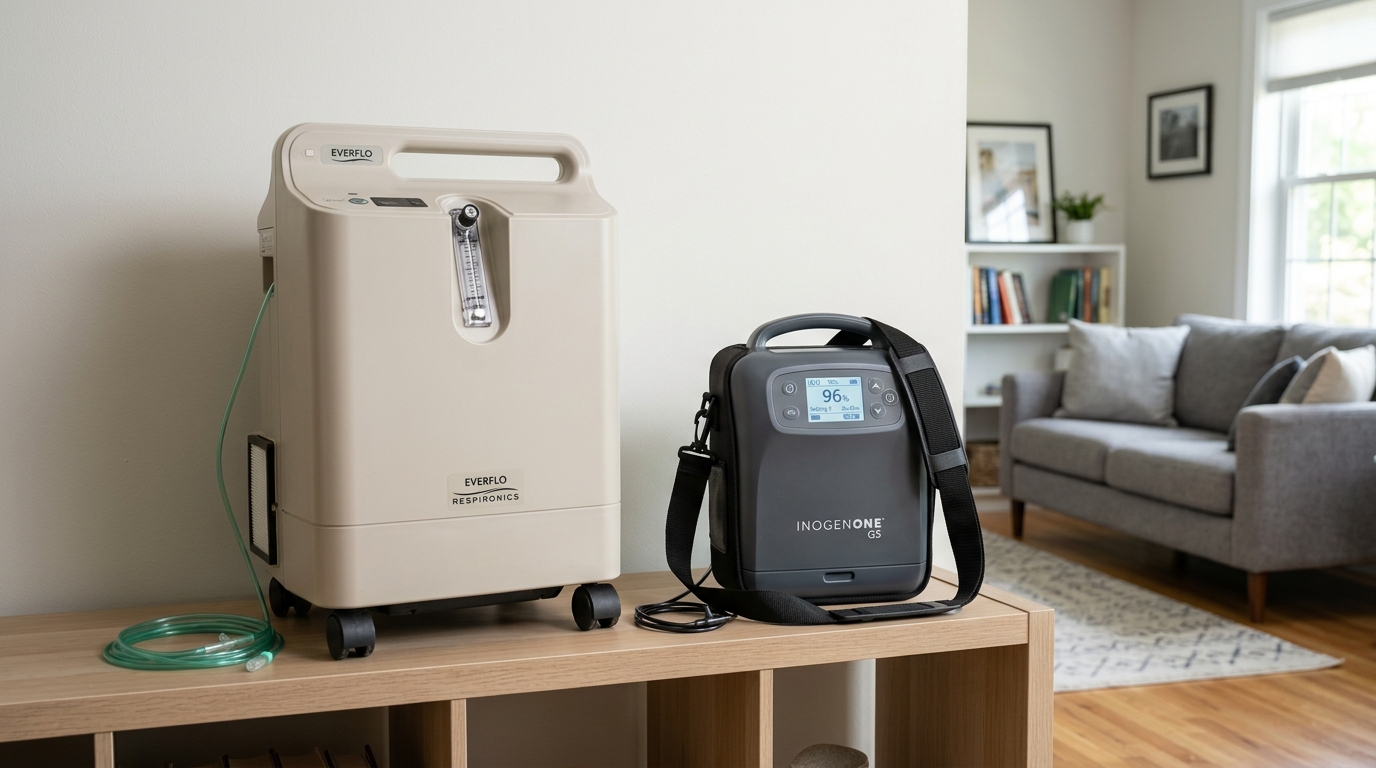
Some COPD patients end up using both — a robust, stationary 5L or 10L continuous-flow concentrator at home (such as Philips EverFlo or Yuwell), paired with a portable pulse-dose unit for outings. This dual setup should be guided by a pulmonologist's pulse oximetry testing at rest and during physical activity.
Best Oxygen Concentrator for Travel
If mobility and travel within Pakistan or internationally are priorities, several factors matter beyond flow type:
- Weight and size: Truly portable units typically weigh under 3 kg with shoulder straps or wheeled carts.
- Battery runtime: Look for units offering swappable external battery packs providing 4 to 8 hours of runtime per charge.
- Pulse dose settings: Confirm the device's numerical settings actually deliver your prescribed oxygen volume, as pulse settings are not universal across brands.
- Airline compliance (FAA approval): If flying on commercial flights (PIA, Emirates, Qatar), airlines strictly mandate FAA-approved portable oxygen concentrators and require 150% battery coverage for flight duration.
- Noise level: Modern portable units operate below 40 dB, making them discreet in public spaces and transit.
Portability is convenient, but it should never come at the cost of receiving your prescribed therapeutic oxygen volume. A compact unit that fails to maintain 90%+ SpO2 is unsafe.
Oxygen Concentrator Settings Explained
Concentrator settings can look confusing, but they break down into simple concepts:
- Flow rate (LPM): Measures litres of oxygen delivered per minute (e.g., 2 LPM, 5 LPM). This is prescribed by your doctor and must never be altered without medical advice.
- Pulse setting (1–5 or 1–6): On pulse-dose units, numbers represent bolus milliliter volumes per breath, not literal continuous LPM.
- System Alarms: Built-in alerts for low battery, low oxygen concentration (<82%), breath absence, or power loss.
- Dual-mode capability: Some larger transportable units support switching between pulse dose and continuous flow up to 2 LPM.
How to Decide Which One You Need
The starting point is always your clinical prescription, not aesthetics or price. Consider these key questions with your healthcare provider:
- What is my prescribed oxygen flow rate at rest, during exercise, and during sleep?
- Does my natural breathing pattern reliably trigger a pulse-dose sensor?
- Do I need mobility outside the house, or is this primarily for bedside/nighttime use?
- Would a stationary unit combined with a portable unit or cylinder backup suit my routine best?
Getting these answers ensures you select equipment with exact medical specifications in hand. You can view our full range of oxygen concentrators for rent and sale or explore portable concentrator options across Pakistan.
Frequently Asked Questions (FAQs)
1. Can I switch between continuous flow and pulse dose on the same device?
Some transportable units (like the Respironics SimplyGo) offer both continuous flow up to 2 LPM and pulse dose up to setting 6. Ultra-light portable models, however, are usually pulse-dose only. Check device specs before purchasing.
2. Is pulse dose as effective as continuous flow for oxygen therapy?
Pulse dose is highly effective for patients who breathe nasal-only and trigger the breath sensor cleanly. However, for shallow breathers or patients requiring high continuous flows (>3 LPM), continuous flow is required.
3. Why do some doctors recommend continuous flow for sleep even if pulse dose works fine during the day?
During deep sleep, breathing becomes shallow, slower, and frequently transitions to mouth breathing. A pulse unit may fail to sense these subtle breaths, causing dangerous drops in nocturnal oxygen levels.
4. Do portable oxygen concentrators work as well as stationary ones?
Stationary units deliver heavy-duty 24/7 continuous oxygen output (up to 5L or 10L per minute) from wall power. Portable units prioritize battery efficiency and mobility. Both work exceptionally well when matched to the right clinical use case.
5. Can I use a pulse dose concentrator while sleeping?
Only if your doctor conducts an overnight titration test confirming that the device detects every breath during REM and non-REM sleep. In most clinical cases, stationary continuous flow is preferred for overnight safety.
6. How do I know what flow rate or pulse setting I need?
Your doctor determines this by monitoring your arterial blood gases or pulse oximetry reading at rest, during 6-minute walk tests, and during sleep. Never increase or decrease settings without medical approval.
Need an Oxygen Concentrator on Rent or Purchase?
Haider Medical Equipment provides top brands including Philips EverFlo, DeVilbiss, Inogen, and Yuwell with 24/7 delivery across Karachi, Lahore, Islamabad, Rawalpindi, and Peshawar.